Do Looksmaxxing Apps Actually Work? (2026)
Short answer: looksmaxxing apps work as measuring tapes, not judges. They can estimate things like facial proportions, canthal tilt and symmetry from a photo with decent consistency if you take the photo the same way every time. What they cannot do is give you a true, fixed “attractiveness score”. That number moves with lighting, camera distance, head angle and expression, it is built on a template you cannot see, and most apps publish no accuracy data at all. Use them to track habits and spot changeable things (skin, hair, body fat, grooming), and ignore the score as a verdict on your worth.
If you have ever scanned your face, got a 5.8, retaken the photo near a window and got a 6.4, congratulations: you have already run the most important experiment in this whole article. Here is what is really going on inside these apps, why the number jumps around, and how to get something useful out of them without letting a phone decide your mood.
What Looksmaxxing Apps Actually Do
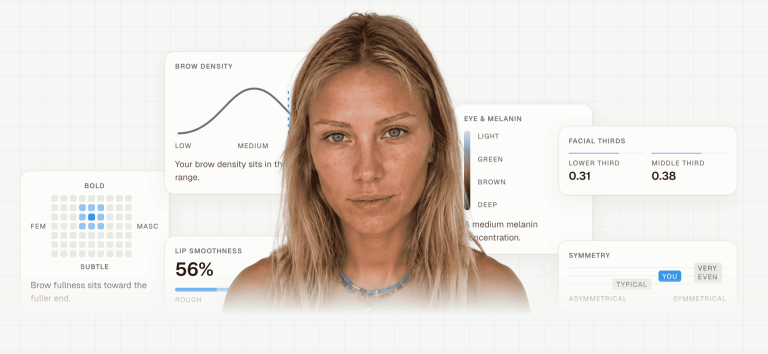
Almost every face rating app follows the same basic recipe. You upload a selfie, the app finds landmarks on your face (eye corners, nose tip, jaw points and so on), it calculates ratios and angles between those points, and then it feeds those numbers, plus sometimes the raw image, into a model that spits out scores. Some apps also use a general AI vision model that writes friendly-sounding feedback on top.
That means there are really two very different kinds of output hiding in the same report:
- Measurements. Things like canthal tilt, facial width-to-height ratio (FWHR), facial thirds and left-right symmetry. These are geometry. If the landmarks are placed well and the photo is taken properly, they are reasonably repeatable.
- Judgments. The overall score, “potential”, tier labels and percentile rankings. These depend on what the app’s makers decided counts as attractive, and almost none of them show their method.
Keep those two buckets separate in your head and the whole topic gets a lot less stressful. A measurement can be useful. A judgment is an opinion with a decimal point.
Why Your Score Changes Every Time You Scan
This is the most common complaint about these apps, and it has a boring, scientific explanation. Photos of faces are surprisingly unstable, and small changes in how you take them change what the software sees.
Camera distance distorts your face
Selfies are usually taken at arm’s length, and close-up lenses exaggerate whatever is nearest the camera. A 2018 study in JAMA Facial Plastic Surgery calculated that a selfie taken at about 12 inches makes the nose look roughly 30% wider in men (29% in women) than a distortion-free photo. If your nose looks wider, your proportions look different to the app, and your score moves even though your face did not.
Head angle changes how people (and models) rate you
Tilting your chin up or down shifts how your jaw, eyes and face shape read. In a 2020 study in Evolutionary Psychology, tipping the face upward steadily increased ratings of masculinity and dominance while lowering ratings of attractiveness. If human raters react to a few degrees of tilt, an algorithm measuring angles will too.
Selfies and filters change the impression
A Stanford survey of 223 people compared a proper camera portrait with phone selfies at 12 and 24 inches, with and without a filter. People’s answers for attractiveness, approachability and other traits changed significantly in 14 of 16 questions depending on which photo they saw (Kandathil et al., 2020). Same woman, same day, different “score”.
Lighting and expression do the rest
Overhead bathroom lights create shadows under your eyes and cheekbones. Window light from the front softens skin texture. A slight smile lifts the cheeks and changes the eye shape. Each of these nudges landmark placement and skin analysis, and the app has no way to know you just stood in a worse spot.
The Template Problem: Whose Idea of Attractive?
There is real science on facial attractiveness, which is why these apps are not total nonsense. A large meta-analysis by Langlois and colleagues found that people agree quite a lot about who is attractive, both within and across cultures. A review by Gillian Rhodes found that averageness, symmetry and sex-typical features tend to be rated as attractive in many cultures.
But “people tend to agree” is not the same as “this app has measured you correctly”. The app still has to pick which features to weigh, how much, and against which reference faces. If the training data skews toward one group, the scores skew too. The classic warning is the 2016 Beauty.AI contest, where an algorithm judging thousands of entries picked winners who were almost all white, which The Guardian reported as a clear case of biased training data. Modern apps are more polished, but most still do not publish what their scores are based on or how they were tested.
Many apps also judge every face against one narrow template. A strong jaw and a sharp positive tilt might be scored as “better” for everyone, even though faces can be attractive in very different ways. That is why you see people with obviously good-looking faces getting middling numbers, and why scores rarely match what happens in real life.
What Apps Measure Well vs Badly
Here is a practical way to sort the parts of a typical looksmaxxing report:
| Output | How reliable from a selfie | Can you change it? | How to use it |
|---|---|---|---|
| Canthal tilt | Fairly reliable with a level, front-facing photo | Barely (brows, sleep, under-eye care change how it reads) | Know it, then stop worrying about it |
| Facial thirds and FWHR | Okay if the camera is far enough and level | Partly (body fat, beard, hairstyle) | Use to pick haircuts and beard shapes |
| Symmetry | Sensitive to head turn and expression | Small changes (posture, grooming) | Compare only photos taken the same way |
| Skin quality | Very sensitive to light and camera processing | Yes (sunscreen, routine, sleep) | Track month to month in the same light |
| Side profile, jaw and chin | Needs a true side photo; front photos guess | Partly (body fat, posture, beard) | Treat angles as estimates |
| Overall score or tier | Low; changes with every factor above | Indirectly | Ignore as a verdict; at most a rough trend |
| “Potential” score | Not a measurement at all | N/A | Marketing, mostly |
How to Test Any Looksmaxxing App Yourself
You do not need a lab to find out if an app is worth your time. You need 20 minutes, a window and maybe a friend.
- Set up the same light. Face a window in daylight, switch off overhead lights, and avoid strong side light.
- Get the camera back. Have a friend hold the phone at eye level, around 1 to 1.5 metres away, and zoom in slightly instead of stepping closer. A tripod and timer work too.
- Neutral everything. Hair off the forehead, glasses off, relaxed face, teeth lightly together, head level with ears over shoulders.
- Take three photos a few minutes apart without changing anything.
- Scan all three in the same app and write down the overall score and two or three measurements.
- Look at the spread. If your score moves by half a point or more between near-identical photos, that is the app’s noise level. Any “improvement” smaller than that is not real.
- Optional chaos test: take one arm’s-length selfie under the bathroom light and scan it. Watching your score drop is a great cure for taking the number personally.
An app that gives stable measurements on identical photos is useful for tracking. An app that swings wildly is a slot machine with a face filter.
How to Use Looksmaxxing Apps Without Wrecking Your Head
Used well, these tools are like a bathroom scale for your face: handy for trends, useless for self-worth. A few rules keep them in the useful zone.
- Scan rarely. Once a month in the same setup is plenty. Daily scanning only measures your lighting.
- Focus on the changeable stuff. The big wins in our science-based looksmaxxing guide are skin care and sunscreen, a haircut that suits your face, getting body fat down if it is high, sleep, posture and grooming. Apps can help you notice these, not replace them.
- Treat bone-structure numbers as trivia. Your canthal tilt or jaw angle is interesting to know, but no exercise, chewing gum or face tape changes bone. Note it and move on.
- Be careful with apps that sell solutions to problems they found. If the scan “discovers” a flaw and the next screen sells a fix, think about who benefits.
- Do not use a score to decide on surgery. If something genuinely bothers you, talk to a qualified doctor who will look at you in person, not at a selfie.
- Watch your mood. If scanning leaves you feeling worse for hours, or you check the mirror constantly, take a break. That is a sign the tool is using you.
Free vs Paid: Is Paying for a Score Worth It?
Many popular apps let you scan for free and then lock the results. Umax’s own App Store listing, for example, says analysis results require a subscription, with weekly plans in the few-dollars range that add up fast over a year. Paying does not make the score more accurate. You are mostly paying for the unlock, extra scans and features like hairstyle previews.
If you just want the measurements and some practical pointers, start free. Softmaxxy is a free face analysis tool that runs on your phone (no account, an email unlocks the full report), and it focuses on things like canthal tilt, facial ratios, side profile and grooming tips rather than a single verdict. Whatever you use, run the three-photo test above first. If you want a more detailed paid program with human input, our ClinicEvo review walks through what a membership-style service looks like.
So, Do Looksmaxxing Apps Work?
They work for what they can actually do: measuring angles and ratios from a well-taken photo, reminding you about skin, hair and grooming, and showing slow trends if you scan the same way each time. They do not work as an objective ranking of how attractive you are, and nothing in the research says a phone can produce one. Real-world attractiveness also includes things no selfie captures, like how you move, talk, dress, smell and how comfortable you are in your own skin.
So yes, use them. Just use them like a tape measure, not a mirror that talks back.
FAQ
Are looksmaxxing apps accurate?
Partly. Measurements like canthal tilt and facial ratios can be fairly consistent if you take photos the same way, but the overall attractiveness score is not accurate in any strict sense. There is no agreed “true” score to compare it against, and most apps publish no validation data.
Is Umax accurate?
Nobody outside the company can confirm it, because Umax does not publish its method or test results. Users regularly report different scores for similar photos taken in different light or at different angles, which matches what the research says about selfies. Treat its numbers as rough and test it with three identical photos.
Why do I get different scores on different apps?
Each app uses different landmarks, different weights and different reference faces, so they are effectively measuring different things. A 6 in one app and a 7.5 in another does not mean either is right. Compare an app only with itself.
Are face rating apps safe?
Check two things: where your photo goes and how billing works. Some apps upload photos to their servers, some process on the device. Read the privacy policy, avoid apps that are vague about storage, and watch for weekly subscriptions that auto-renew. Also check how you feel after using one; mental safety counts too.
What is a good score on a looksmaxxing app?
There is no universal scale. Many apps compress most people into the 4 to 7 range, and some seem to rarely hand out 8s, which says more about the scale than about faces. A “good” result is one where your controllable habits are trending in the right direction.
Can a looksmaxxing app tell me what to fix?
It can point at changeable things: skin texture, under-eye darkness, haircut and beard shape, and signs of higher body fat. Those suggestions are worth trying. Be skeptical of advice aimed at bone structure, and never use an app score as the reason for a procedure.
Should teenagers use looksmaxxing apps?
Many apps are rated 13+ or 18+, and faces keep changing a lot through the late teens, so scores at 15 say very little about 25. If you are a teen, focus on sleep, skin care, fitness and a good haircut, and skip the ratings.