Best Hosting for Vibe-Coded Apps (2026): Vercel vs Netlify vs Cloudflare Pages and More
You built an app in Lovable, Bolt, v0 or Cursor, and now you want to know where it should live. Vercel? Netlify? Cloudflare Pages? Something like Render, Railway or Fly.io? Or should you just leave it on the builder’s own hosting?
This guide compares the best hosting for vibe-coded apps side by side: free tiers, what the first paid plan costs, the limits that catch people out, and which host fits which kind of app. Here’s the thing most hosting roundups miss, though. For a small app, hosting is cheap. Most of these hosts are free or close to it. The real cost is lock-in: your code, database and settings living on accounts you don’t control. If you only care about getting a Lovable app off lovable.app, my Lovable hosting alternatives guide walks through that move host by host, so I’ll keep this one focused on the comparison.
Quick answer: for most vibe-coded apps, Vercel is the easiest home, Netlify and Cloudflare Pages are the best free options for a business site, and Render, Railway or Fly.io only make sense when your app needs a real server. Whichever you pick, make sure the host, GitHub and Supabase accounts are yours.
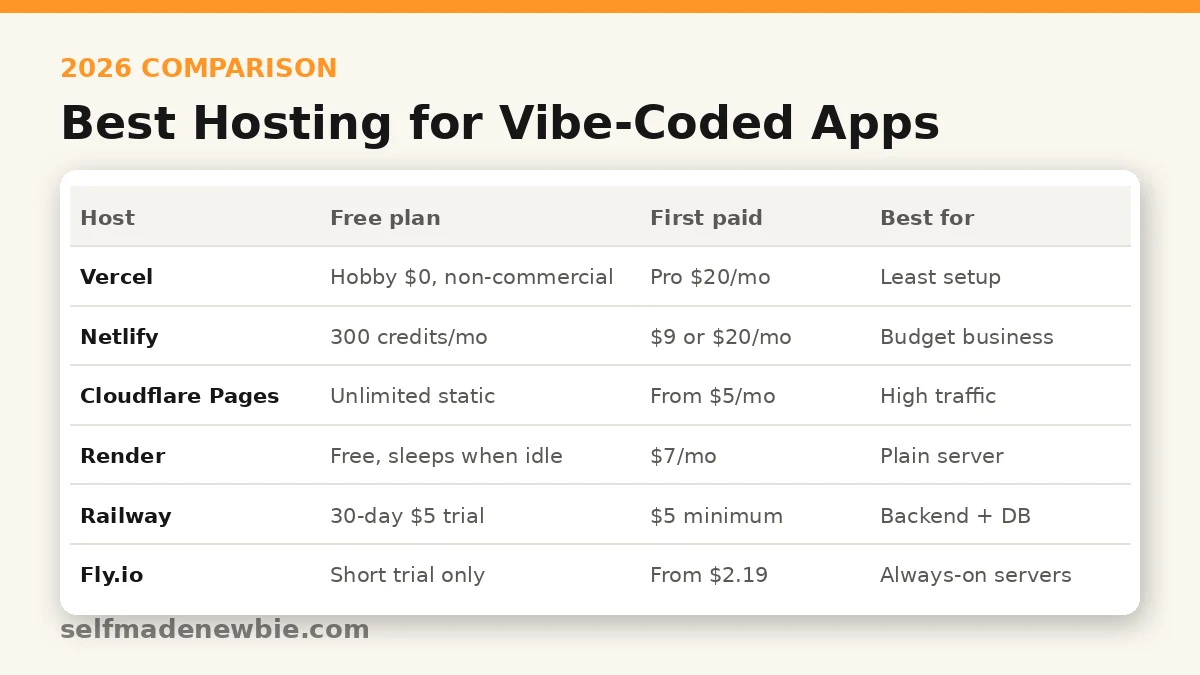
| Host | Free plan | First paid plan | Best for | Watch out for |
|---|---|---|---|---|
| Vercel | Hobby, $0 | Pro, $20/month (includes $20 usage credit) | Least setup, Next.js and v0 apps | Hobby is for non-commercial personal use only |
| Netlify | Free, $0, 300 credits a month | Personal $9/month, Pro from $20/month | Small business sites on a budget | A production deploy uses 15 credits |
| Cloudflare Pages | Free, $0, unlimited static requests | Workers Paid from $5/month | High traffic at low cost | 500 builds a month on Free |
| Render | Static sites free, free web service | Starter $7/month | Apps that need a plain server | Free services sleep after 15 minutes idle |
| Railway | 30-day trial with $5 credits | Hobby, $5 minimum usage | Backends and databases together | Usage-based, so bills move |
| Fly.io | No free tier (short trial) | From $2.19 per 30 days | Always-on servers close to users | Card needed after the trial |
| Lovable or Bolt hosting | Free on the builder address | $25/month for your own domain | Prototypes and early testing | Your app stays on the builder |
Hosting is the cheap part. Owning it is what matters. Launch Mango moves your Lovable, Bolt, v0 or Cursor app onto your own GitHub, Supabase and Vercel accounts, so you aren’t locked into the builder. Own Your App is $79 one-off: code, database and env vars moved, live at a real URL with a plain-English handover report, usually in 1 to 2 days. Own and Secure is $199 one-off and also fixes sign-in and redirects, Supabase RLS, exposed API keys and live Stripe payments, with a security report and your custom domain included. Money back if it isn’t live on your accounts. Not sure what your app needs? Run the free 2-minute app check.
What Is the Best Hosting for Vibe-Coded Apps?
For most vibe-coded apps, Vercel is the best hosting because it detects the framework, deploys from GitHub and needs almost no setup. Netlify and Cloudflare Pages are the best free picks for a business, and Render, Railway or Fly.io suit apps that need a long-running server. Pick the host on your own account.
Most apps built in Lovable, Bolt, v0 or Cursor are a frontend (React with Vite, TanStack Start or Next.js) that talks to Supabase for sign-in and data. That shape is exactly what the frontend hosts were built for. You connect a GitHub repo, the host builds it, and every push goes live. No server to manage.
Here’s how I’d rank them for a typical vibe-coded app:
- Vercel: the easiest all-rounder, and the natural home for Next.js and v0 apps. Free for personal projects, Pro is $20 a month once you make money from it.
- Netlify: just as easy, and its Free plan doesn’t ban commercial use. The credit system takes a minute to understand.
- Cloudflare Pages: the cheapest at scale, because requests to static assets are free and unlimited. A bit more setup.
- Render, Railway and Fly.io: only when your app needs its own server process, like a Node backend, a queue or websockets.
- Lovable or Bolt hosting: fine for testing and prototypes, but your app stays on the builder’s accounts.
Why Is Lock-In the Real Cost of Hosting a Vibe-Coded App?
Because the hosting bill for a small app is usually $0 to $25 a month, while getting out later costs days of work. If your code, database and env vars sit on the builder’s or a freelancer’s accounts, every change, fix or move depends on them. Owning the accounts is what keeps hosting cheap.
Look at the table above again. Nearly every host has a free plan, and the paid plans start between $5 and $25 a month. For a new app with a few hundred users, the hosting bill is a rounding error. So why do so many people end up stuck?
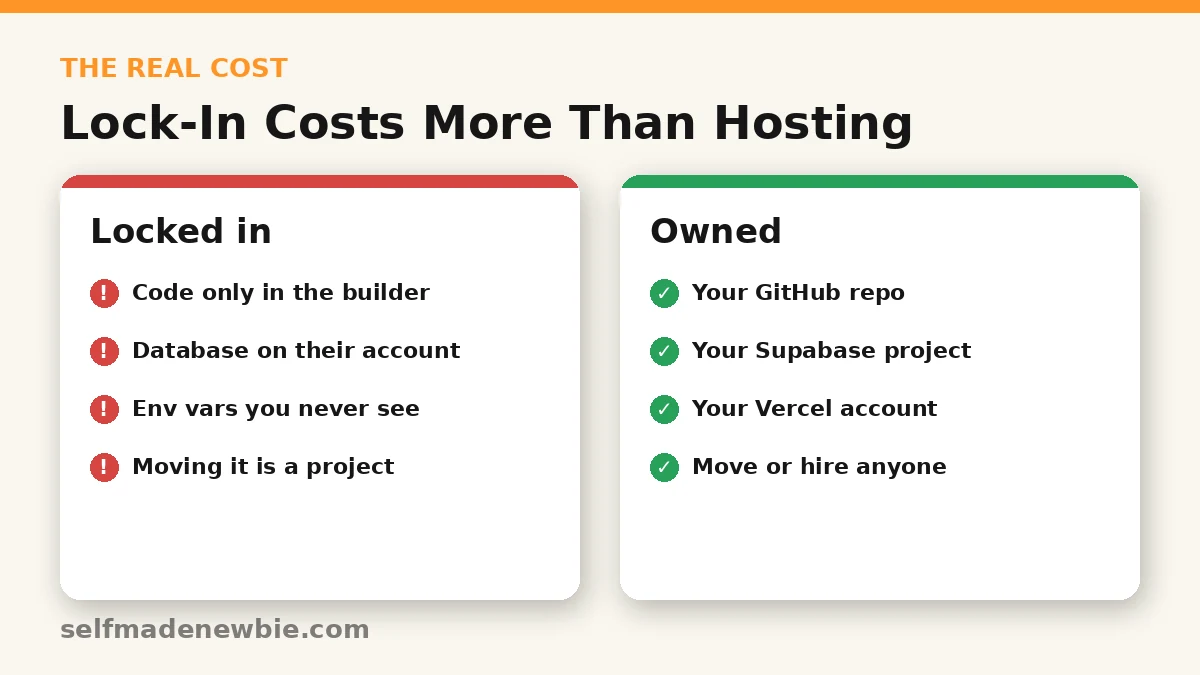
Because “where it’s hosted” is really three questions:
| Question | Locked in | Owned |
|---|---|---|
| Where does the code live? | Only inside the builder’s editor | Your own GitHub repo |
| Where does the data live? | A database the builder or a freelancer controls | Your own Supabase project |
| Who holds the settings? | Env vars and keys only the builder knows | Env vars on your own host account |
| Who can move it? | Whoever owns the accounts | You, or anyone you invite |
Lovable is a good example. Publishing to a lovable.app address is free on every plan, and GitHub sync works on the Free plan too. But editing and downloading the code and connecting a custom domain need a paid plan. That’s fair, it’s how they make money. Just know that “free hosting” on a builder often means “free until you want to leave or use your own domain.”
The same thing happens with freelancers who deploy your app onto their own Vercel or Supabase account. I covered that risk in my guide to alternatives to hiring a developer. The fix is boring but it works: create the GitHub, Supabase and host accounts in your own name first, then move the app in.
Is Lovable or Bolt Built-In Hosting Good Enough?
For testing and early users, yes. Lovable and Bolt both publish your app for free on their own address with HTTPS included. The trade-offs are that your own domain needs a $25 a month plan, and the app keeps living on the builder’s accounts, which makes it harder to move, hand off or fix outside the builder.
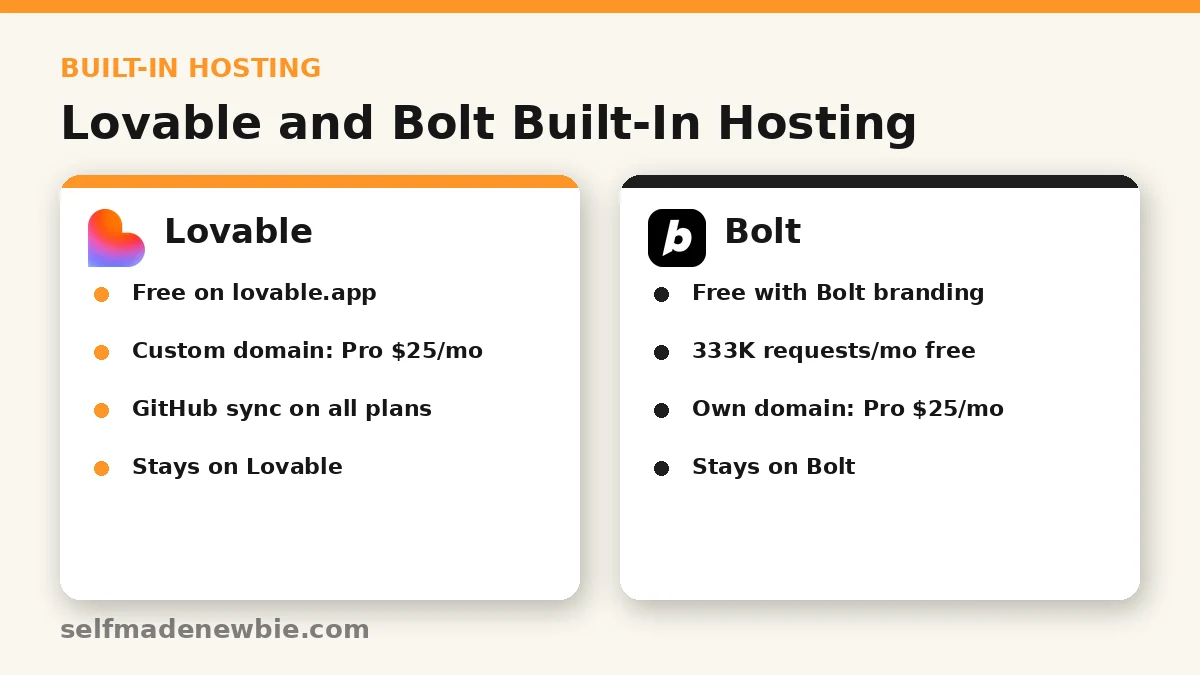
| Lovable hosting | Bolt hosting | |
|---|---|---|
| Free publishing | Yes, on a lovable.app address (Lovable plans) | Yes, with Bolt branding (Bolt pricing) |
| Free plan traffic | Small apps usually covered by the monthly Cloud grant | 333K web requests a month |
| Your own domain | Paid plan, Pro is $25/month | Pro, $25/month (billed monthly) |
| Code access | GitHub sync on all plans, edit and download code on paid plans | Download the project or push it to GitHub |
| Who owns the accounts | Lovable | Bolt |
I like built-in hosting for what it is. One click and your app is online with HTTPS. My Lovable vs Bolt comparison goes deeper on how each one publishes. But neither publish button checks your database permissions, moves your data to your own Supabase or switches Stripe to live mode. Published isn’t the same as production-ready.
Builder hosting: pros and cons
- Pro: free, instant and zero setup.
- Pro: HTTPS and a working URL out of the box.
- Con: your own domain costs $25 a month, every month.
- Con: the app stays on the builder’s accounts, so moving it later is a project.
Vercel vs Netlify vs Cloudflare Pages: Which Is Best for a Vibe-Coded App?
Vercel is best if you want the least setup and can pay $20 a month once the app makes money. Netlify is best for a small business on a free or $9 plan. Cloudflare Pages is best for lots of traffic at a low price, since static requests are free and unlimited. All three connect to GitHub and Supabase.
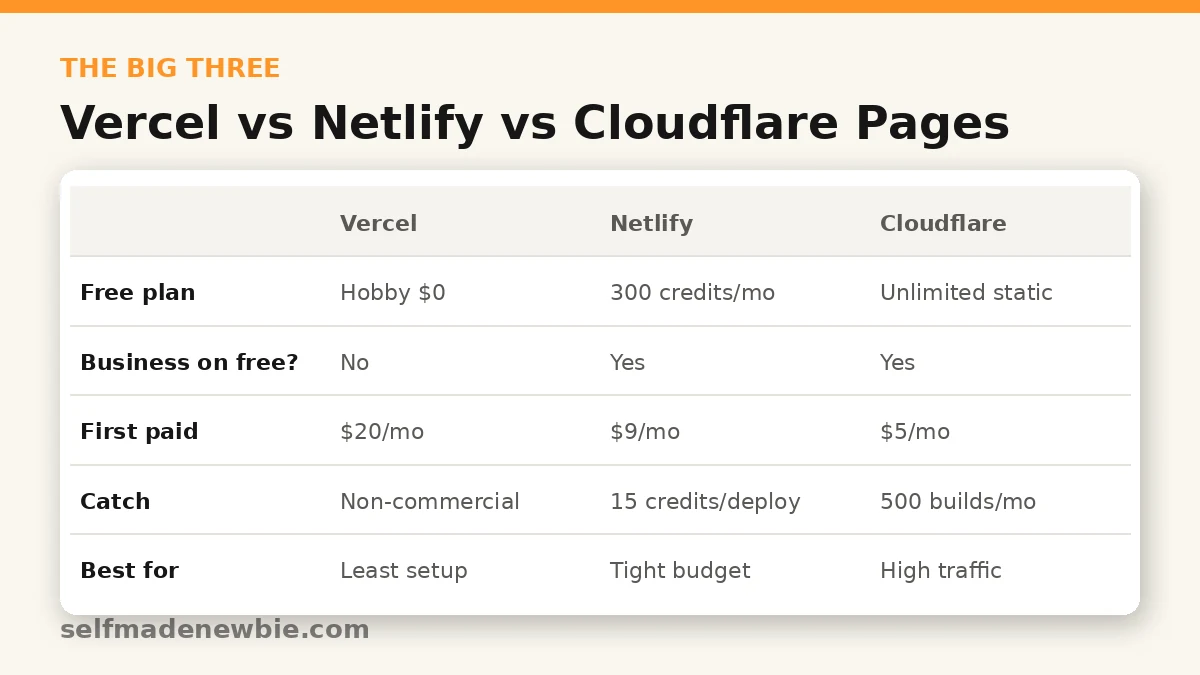
This is the comparison most people searching vercel vs netlify vs cloudflare pages actually need. All three host a React, Vite, TanStack Start or Next.js frontend well. The differences are in the free-plan rules:
| Vercel | Netlify | Cloudflare Pages | |
|---|---|---|---|
| Free plan | Hobby: 1M CDN requests, 100 GB data transfer, 4 hours active CPU a month (source) | 300 credits a month, hard limit (source) | Unlimited static requests, 500 builds a month (source) |
| Commercial use on free | No, Hobby is non-commercial personal use only (source) | Allowed | Allowed |
| First paid plan | Pro $20/month with $20 usage credit | Personal $9/month (1,000 credits), Pro from $20/month | Workers Paid from $5/month |
| How usage is counted | Requests, data transfer and compute | Credits: 15 per production deploy, 20 per GB, 2 per 10,000 requests | Functions requests; Workers Free allows 100,000 a day |
| Best for | Next.js, v0 apps, least setup | Small business apps on a budget | High traffic, low cost |
Vercel: pros and cons
- Pro: the smoothest GitHub to live flow, with preview links for every change.
- Pro: the home of Next.js, so v0 apps just work.
- Con: Hobby can’t be used for a commercial app, so plan on $20 a month.
- Con: single-page apps still need a rewrite rule to avoid 404s on refresh.
Netlify: pros and cons
- Pro: the Free plan allows a business site.
- Pro: simple dashboard with forms and redirects built in.
- Con: credits run out faster than you expect, since 20 deploys use the whole free month.
- Con: hit the hard limit on Free and your projects pause until the next cycle.
Cloudflare Pages: pros and cons
- Pro: static traffic is free and unlimited, even on the free plan.
- Pro: up to 100 custom domains per project on Free.
- Con: server-side features run as Workers, which take more setup.
- Con: the dashboard is busier than Vercel’s or Netlify’s.
One tip from this series: whichever of the three you choose, the same two problems show up after the first deploy. Routes break on refresh (my Vercel 404 on refresh fix covers all three hosts) and env variables come through empty (see Vite env variables not working).
When Should You Use Render, Railway or Fly.io Instead?
Use Render, Railway or Fly.io when your app needs a long-running server: a Node or Python backend, websockets, background jobs or a database next to the app. Most Lovable, Bolt and v0 apps don’t, because Supabase is the backend. For a plain frontend plus Supabase, a frontend host is simpler and cheaper.
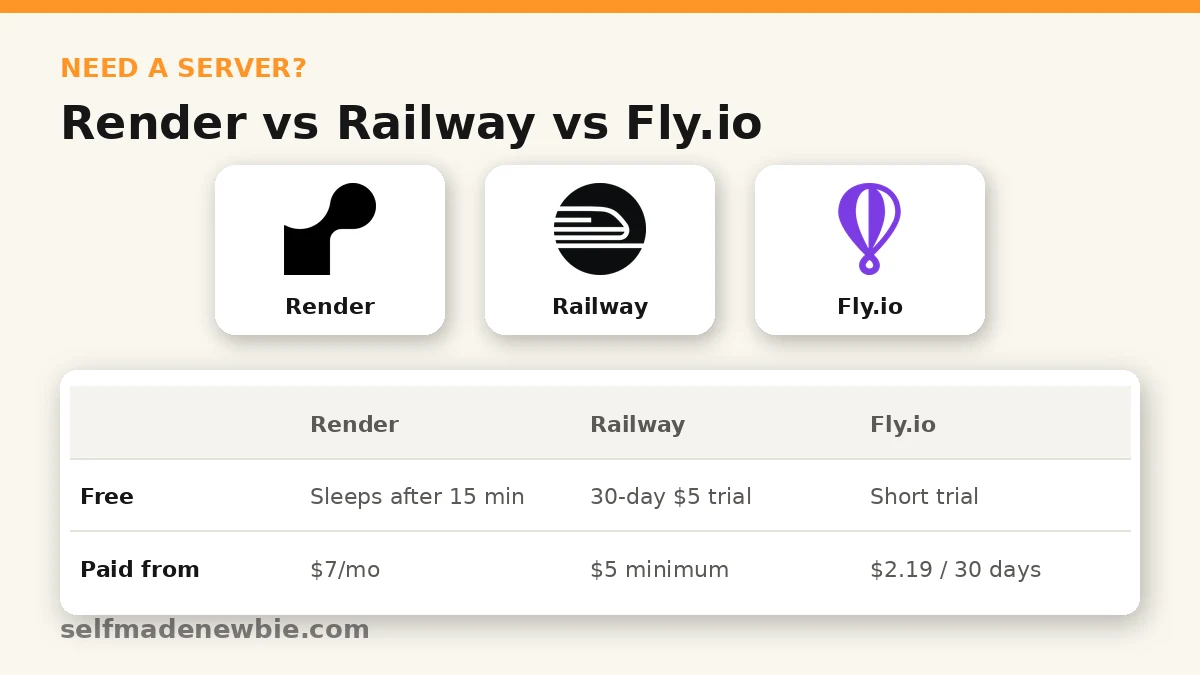
| Render | Railway | Fly.io | |
|---|---|---|---|
| Free option | Static sites free; free web service sleeps after 15 minutes idle (source) | 30-day trial with $5 credits, then $1/month (source) | No free tier; trial of 2 hours of machine time or 7 days (source) |
| First paid step | Starter $7/month, 512 MB (source) | Hobby, $5 minimum usage with $5 credit included | Always-on 256 MB machine from $2.19 per 30 days |
| Database | Free Postgres expires after 30 days | Add a database in the same project | Volumes and managed options |
| Best for | A simple Node server with a predictable bill | Backend and database together, quick setup | Always-on servers in regions near users |
These are good platforms. They’re just a different tool. If your app is a React frontend talking to Supabase, a server host adds cost and moving parts without much benefit. If your Cursor build has its own Express or FastAPI backend, that’s when Render or Railway earns its place, with the frontend on Vercel, Netlify or Cloudflare.
One soft warning: Render’s free web service takes a while to wake up after it sleeps, so the first visitor after a quiet spell waits. For a demo, fine. For paying users, budget the $7 Starter plan.
How Much Does Hosting a Vibe-Coded App Really Cost?
A small vibe-coded app can run for $0 a month on free plans, as long as it isn’t commercial on Vercel Hobby and Supabase stays active. A real business app usually lands around $20 to $45 a month: a paid host plan plus Supabase Pro from $25. A custom domain adds its own yearly fee.
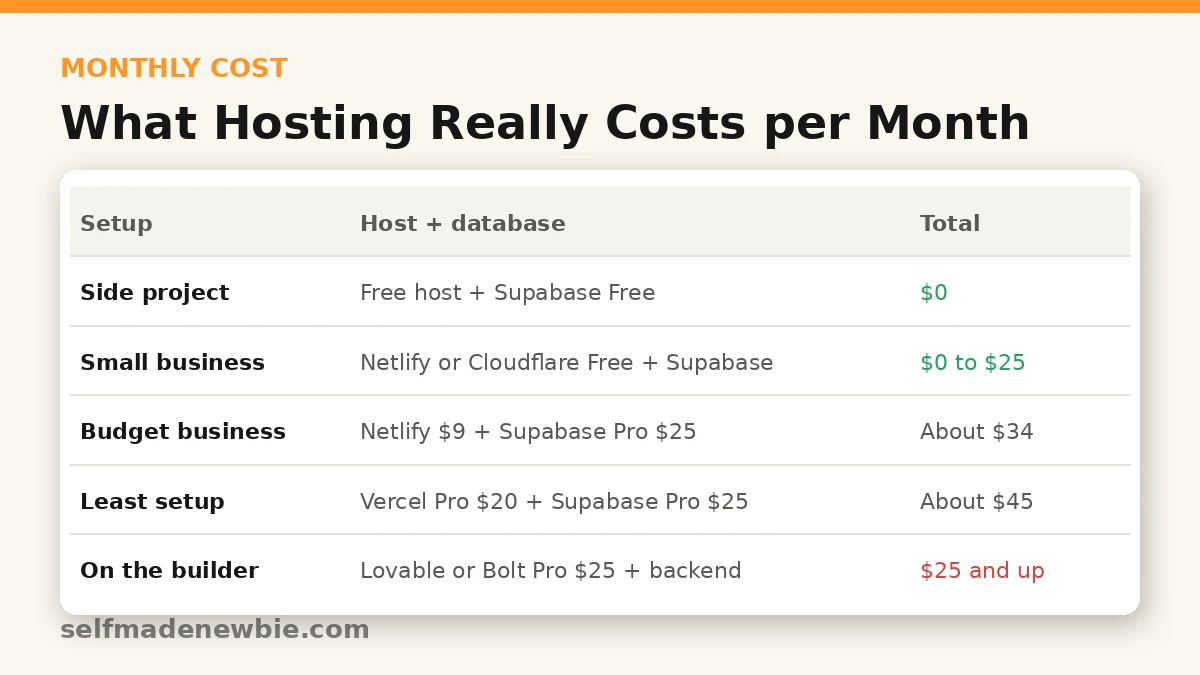
| Setup | Host | Database | Monthly total |
|---|---|---|---|
| Side project, no revenue | Vercel Hobby, Netlify Free or Cloudflare Free ($0) | Supabase Free ($0) | $0 |
| Small business, low traffic | Netlify Free or Cloudflare Free ($0) | Supabase Free ($0) or Pro (from $25) | $0 to $25 |
| Business app, least setup | Vercel Pro ($20) | Supabase Pro (from $25) | About $45 |
| Budget business app | Netlify Personal ($9) | Supabase Pro (from $25) | About $34 |
| Staying on the builder | Lovable or Bolt Pro for a custom domain ($25) | Builder backend or Supabase | $25 and up |
One thing to plan for: Supabase Free projects are paused after 1 week of inactivity, and you get 2 active free projects. That’s fine while you build. Once real users depend on the app, Supabase Pro from $25 a month is usually the first bill worth paying, ahead of a paid host.
Notice the pattern. The monthly numbers are small. What turns a $45 a month app into a stressful one is not knowing who owns which account, or finding out a key was exposed after launch.
What Is the Best Hosting for a Lovable App?
For a Lovable app, the best hosting is usually Vercel on your own account, with your database in your own Supabase project. Netlify and Cloudflare Pages are good free alternatives for a business site. Staying on Lovable hosting is fine for testing, but your own domain needs a paid Lovable plan.
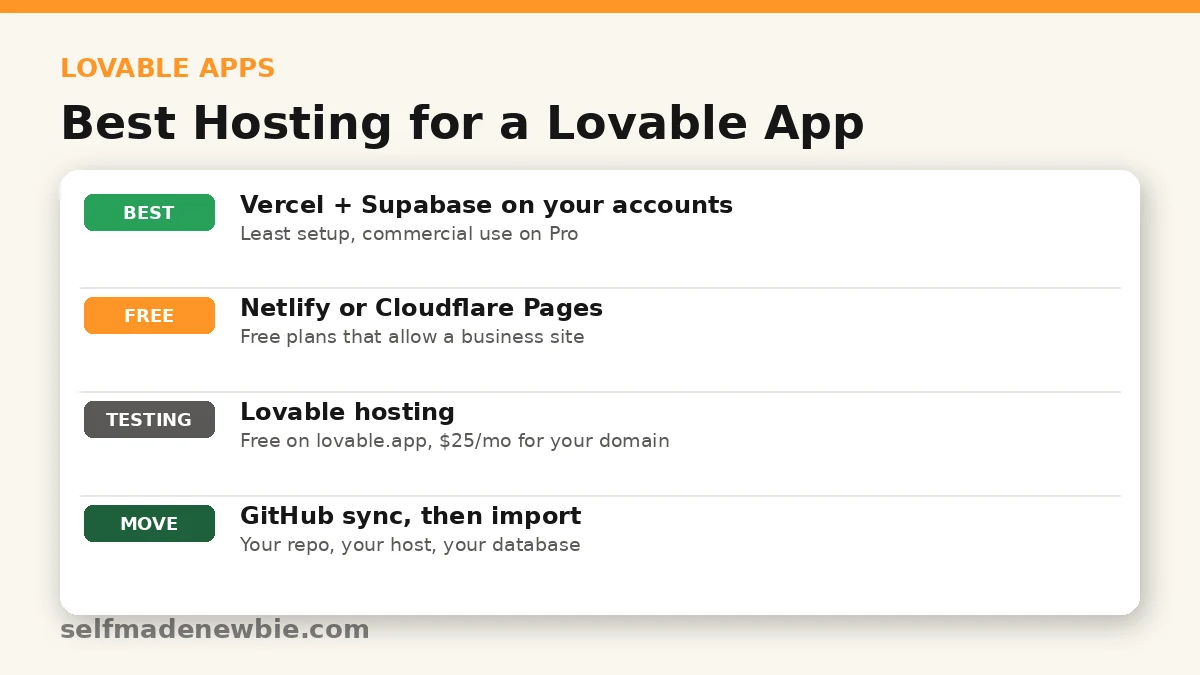
Lovable apps are either React with Vite or TanStack Start, and all three frontend hosts detect both. The exact build settings, export steps and the order to move things in are in my Lovable hosting alternatives guide, so I won’t repeat them here. The short version of best hosting for a Lovable app:
| Your situation | Best host | Why |
|---|---|---|
| Paying users, want the least setup | Vercel Pro on your account | Smoothest deploys, commercial use allowed |
| Small business, tight budget | Netlify Free or Personal | Free plan allows commercial use |
| Lots of traffic | Cloudflare Pages | Static traffic is free and unlimited |
| Still testing the idea | Lovable hosting | Free, one click, nothing to move yet |
If you’re on Lovable mainly for the custom domain, compare the $25 a month against a free host plus the domain itself. My Lovable custom domain guide covers the DNS and SSL side either way. Bolt apps follow the same logic.
What Breaks When You Move a Vibe-Coded App to a New Host?
Usually the same six things: routes that 404 on refresh, empty env variables, sign-in that redirects to localhost, Supabase RLS that is off or too loose, Stripe webhooks pointing at the old URL, and a custom domain stuck on DNS or SSL. None are the host’s fault. The builder handled them quietly before.
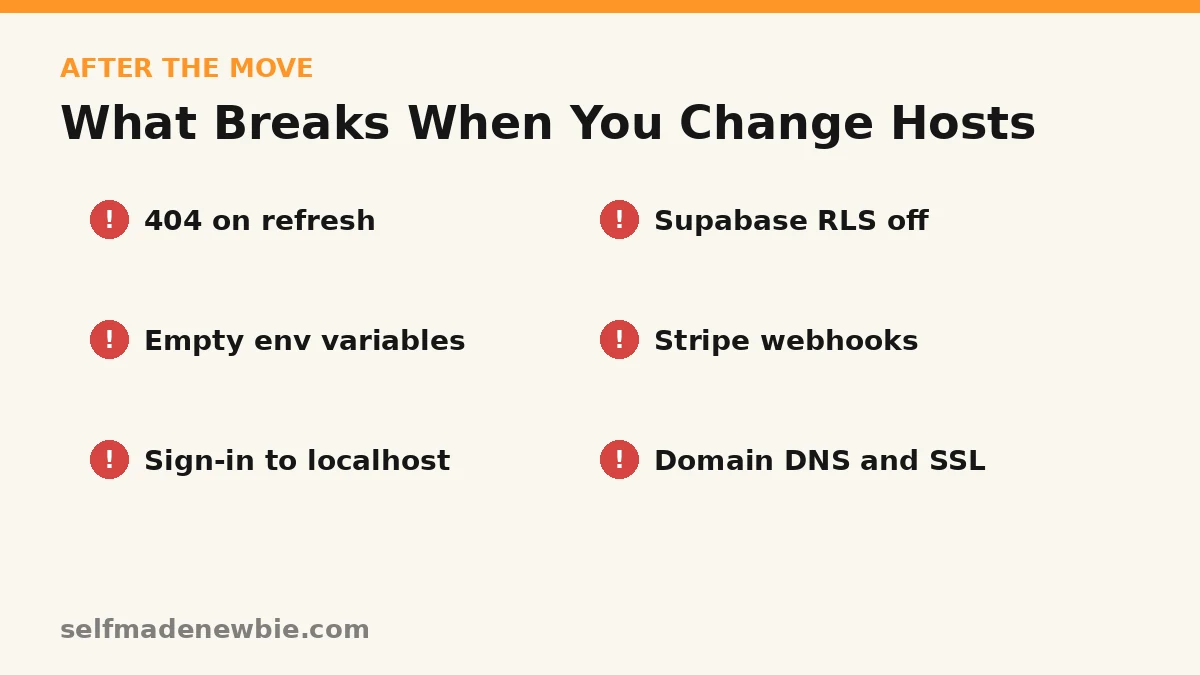
| What breaks | Why | Fix guide |
|---|---|---|
| Routes 404 on refresh | The host needs a rewrite to index.html | Vercel 404 on refresh |
| Env variables are empty | Vite needs the VITE_ prefix and values set on the host | Vite env variables not working |
| Sign-in goes to localhost | Supabase and Google still list the old URL | OAuth redirect to localhost |
| Anyone can read the data | Row level security is off or too loose | Supabase RLS |
| Payments don’t unlock | Stripe webhooks still point at the old URL or test mode | Stripe webhook not working |
| Domain won’t connect | DNS records or SSL not set on the new host | Lovable custom domain |
This is why I keep saying the host choice is the easy part. If you work through these in order, the full list is in my checklist to launch your vibe-coded app.
Which Host Should You Pick for Your Vibe-Coded App?
Pick Vercel if you want the least setup and will pay $20 a month for commercial use. Pick Netlify or Cloudflare Pages if you want a free plan that allows a business site. Pick Render, Railway or Fly.io only if you need a server. Whatever you choose, put it on accounts you own.
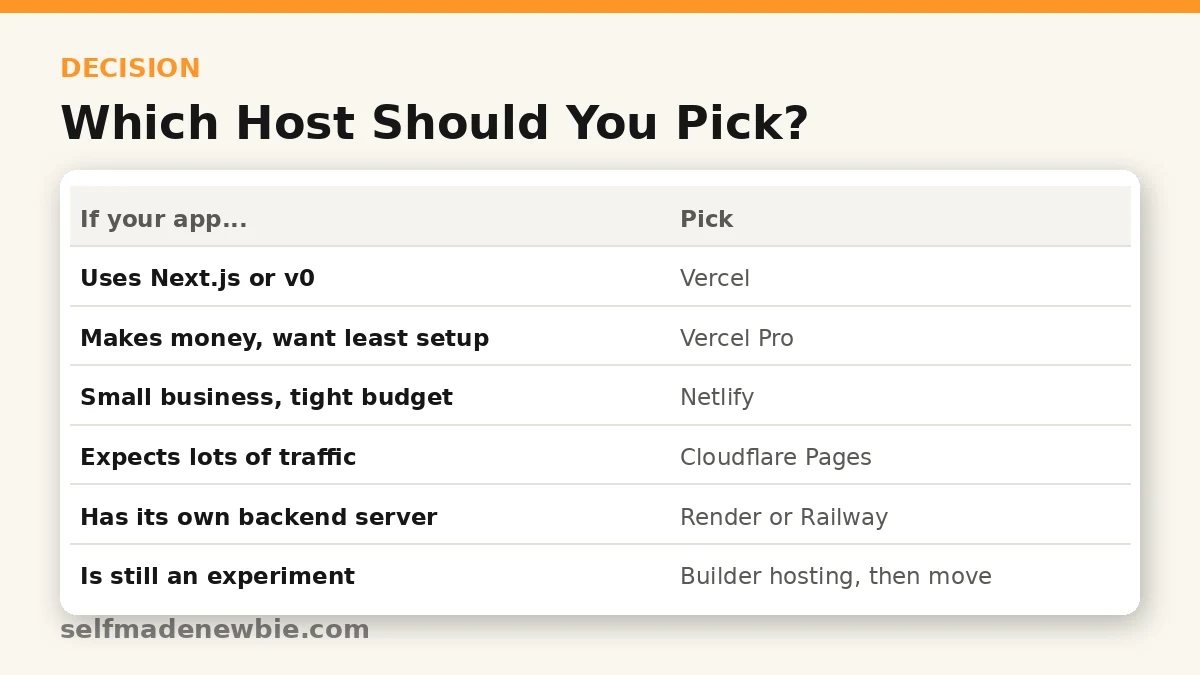
| If your app… | Pick |
|---|---|
| Is built in v0 or uses Next.js | Vercel |
| Makes money and you want the least setup | Vercel Pro |
| Is a small business on a tight budget | Netlify Free or Personal |
| Expects lots of traffic | Cloudflare Pages |
| Has its own Node or Python backend | Render or Railway, frontend on a frontend host |
| Needs always-on servers near users | Fly.io |
| Is still an experiment | Lovable or Bolt hosting, then move it |
Not sure whether to do the move yourself? My DIY vs done-for-you deployment guide breaks down the time and risk. And if you’d rather compare services that do it for you, see the best app launch services.
Best Hosting for Vibe-Coded Apps FAQ
What is the best free hosting for a vibe-coded app?
For a business app, Netlify Free and Cloudflare Pages Free are the best free options, because both allow commercial use. Vercel Hobby is free and the easiest to set up, but it’s limited to non-commercial personal projects (see when Vercel pauses your Hobby team). Pair any of them with a Supabase Free project.
Can I use Vercel Hobby for a commercial app?
No. Vercel’s fair use guidelines say Hobby is restricted to non-commercial personal use, and any deployment used for financial gain needs Pro or Enterprise. Vercel Pro is $20 a month and includes $20 of usage credit.
Is Netlify or Vercel better for a Lovable app?
Both work well, since each detects Vite and TanStack Start apps. Vercel has the smoothest setup and is $20 a month for commercial use. Netlify’s Free plan allows a business site but counts usage in credits, with 15 credits for every production deploy.
Do I need to pay Lovable to use a custom domain?
Only if you keep hosting on Lovable. A custom domain on Lovable hosting needs a paid plan, starting with Pro at $25 a month. Host the same app on Netlify, Cloudflare Pages or Vercel instead and you can connect your domain there.
Do I need Render, Railway or Fly.io for a Lovable or Bolt app?
Usually not. Most Lovable and Bolt apps use Supabase as the backend, so a frontend host is enough. Use Render, Railway or Fly.io when your app has its own long-running server, background jobs or websockets.
Where should my Supabase database live?
In a Supabase project on your own account. Supabase Free works while you build, but free projects pause after a week of inactivity, so most live apps move to Supabase Pro from $25 a month. Turn on row level security before real users arrive.
How Do You Get Your App Onto Your Own Vercel and Supabase?
Connect the builder to a GitHub repo you own, create your own Supabase project and move the data, then import the repo into your own Vercel account and set the env vars. After that, fix sign-in redirects, RLS, keys and Stripe. You can do it yourself with the guides above or hand it off.
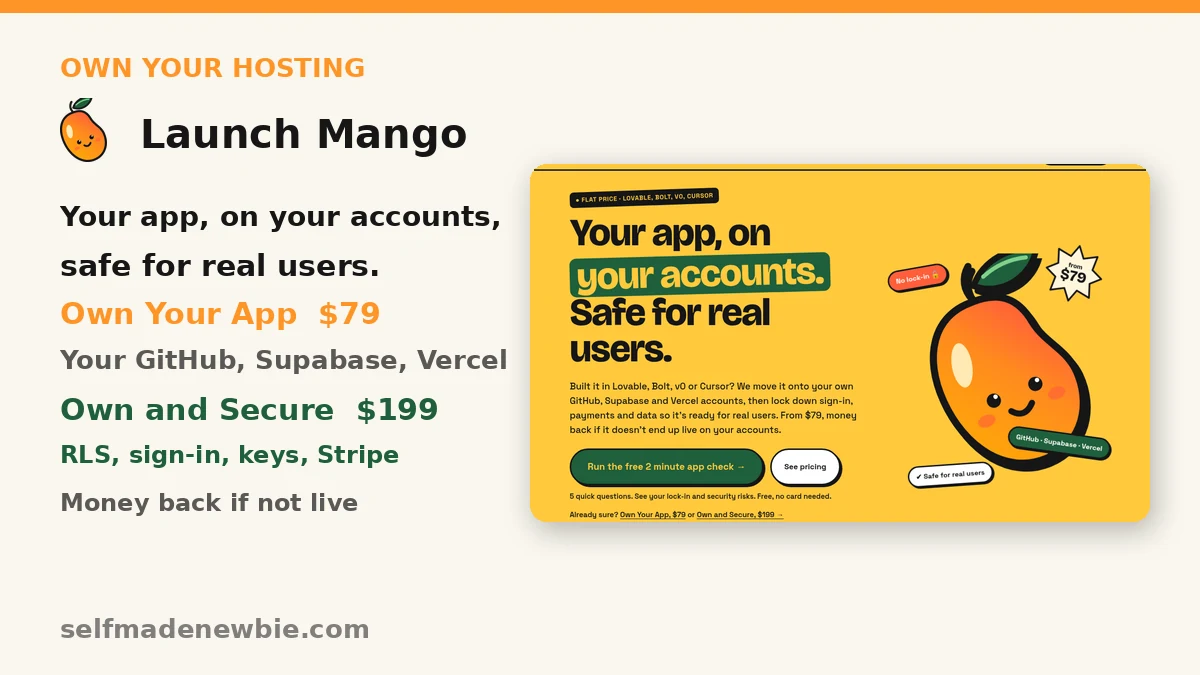
Picking a host takes ten minutes. Getting the app onto accounts you own, and safe for real users, is the part that takes a weekend if you’ve never done it. My checklist to launch your vibe-coded app lays out every step in order.
Handing it off is what we do at Launch Mango. Own Your App ($79 one-off) moves your Lovable, Bolt, v0 or Cursor app onto your own GitHub, Supabase and Vercel accounts, including the code, database and env vars, so you aren’t locked into the builder. It goes live at a real URL with a plain-English handover report, usually in 1 to 2 days. Own and Secure ($199 one-off) is everything in Own Your App plus sign-in and redirects checked and fixed, Supabase RLS and database permissions locked down, exposed API keys removed from the frontend, live Stripe payments and webhooks, a security report and your custom domain included. Either way, your money back if it isn’t live on your accounts, and our team removes itself from your accounts after handover.
Want to see how locked in and exposed your app is first? Run the free 2-minute app check. Or read my Launch Mango review first.
Your app, on your accounts, safe for real users. Cheap hosting, no lock-in.